SIM800C GSM Module with Antenna Bluetooth
Price in Sri Lanka
GSM GPRS GPSCommunication ModulesSIMCOM
Tronic.lk

Rs 3,350
In stock
Updated 01 Nov 2026
Opening hours
Closed now
- Monday09:00 - 19:00
- Tuesday09:00 - 19:00
- Wednesday09:00 - 19:00
- Thursday09:00 - 19:00
- Friday09:00 - 19:00
- Saturday09:00 - 19:00
- SundayToday09:00 - 19:00
Search for it on
Description
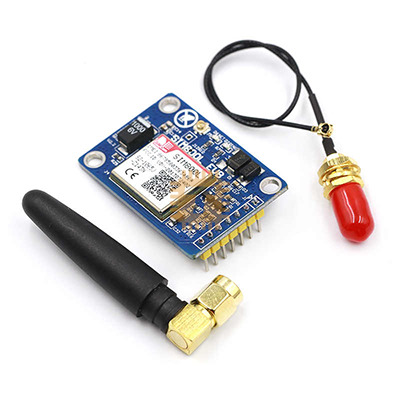
The SIM800C GSM/GPRS Module is a versatile cellular development breakout board engineered for remote telemetry, IoT sensing, voice communication, SMS notifications, and wireless data streaming. Built around the SIMCom SIM800C quad-band engine, it features Bluetooth 3.0 SPP, DTMF decoding, Text-to-Speech (TTS), and flexible power inputs (accepting wide DC voltage or direct single-cell LiPo batteries). Standard 3.3V/5V TTL serial communication via AT commands allows straightforward interfacing with microcontrollers, Arduino boards, and PC serial adapters.
Specifications
- Core Cellular Chipset: SIMCom SIM800C Quad-Band Engine (850 / 900 / 1800 / 1900 MHz)
- Wireless Protocol: 2G GSM / GPRS (Supports standard 2G/3G/4G SIM cards on 2G-compatible networks)
- Bluetooth Protocol: Bluetooth 3.0 with SPP (Serial Port Profile) and audio services
- Operating Supply Voltage:
- VCC_IN: 5V to 18V DC (Onboard step-down regulator, accepts up to 20V max)
- BAT: 3.3V to 4.4V DC (Direct input for 3.7V LiPo or 18650 lithium cells)
- Peak Transmission Current: Up to 2A (Burst current during RF transmissions)
- Serial Logic Level: 3.3V / 5V TTL (Auto-matched via V_M pin)
- Command Interface: Standard and enhanced AT command sets
- Advanced Features: TTS (Text-to-Speech), DTMF detection, SMS, Voice calls, GPRS TCP/IP stack
- SIM Card Slot: Push-pull / self-ejecting Micro-SIM slot
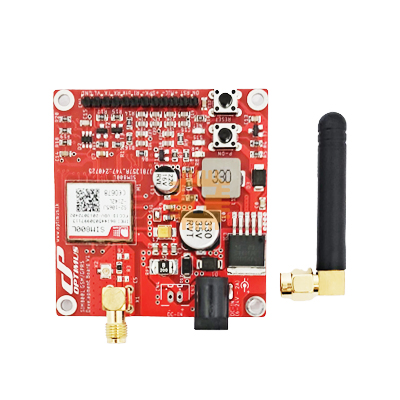
- RF Connectors: Onboard SMA female connector, IPEX (U.FL) pad, and helical spring antenna footprint
Pinout and Interface Guide
- VCC_IN: Main DC Power Input (5V to 18V DC, requires at least 2A peak capability).
- GND: Common System Ground Reference.
- BAT: Direct lithium battery power input (3.3V to 4.4V DC).
- TXD: Primary TTL Serial Output (Transmits AT responses to MCU RX).
- RXD: Primary TTL Serial Input (Receives AT commands from MCU TX).
- V_M: Microcontroller logic voltage reference pin (Connect to MCU 3.3V or 5V rail for precise level matching; can be left unconnected if using default onboard matching).
- PWR: Module power enable control pin (Pull LOW to toggle module power state).
- RI: Ring Indicator output (Pulses LOW on incoming call or SMS).
- DTR: Data Terminal Ready sleep wake-up pin.
- U2_T / U2_R: Secondary auxiliary serial UART pins (Transmit / Receive).
- ADC: Onboard analog-to-digital converter input pin.
- SPP / SPN: Differential audio speaker outputs (Positive / Negative).
- MC+ / MC-: Differential electret microphone audio inputs (Positive / Negative).
Key Features
- Dual Power Flexibility: Can be powered via wide DC voltage (5V–18V) through onboard buck conversion, or directly from a single-cell 3.7V LiPo/18650 battery via the BAT terminal.
- Built-in Bluetooth 3.0: Enables local wireless SPP serial telemetry and audio streaming alongside long-distance cellular links.
- Onboard Level Shifter: Dedicated V_M matching pin ensures clean, level-safe communication with both 3.3V (ESP32, STM32, Raspberry Pi) and 5V (Arduino Uno, PIC) logic without external level converters.
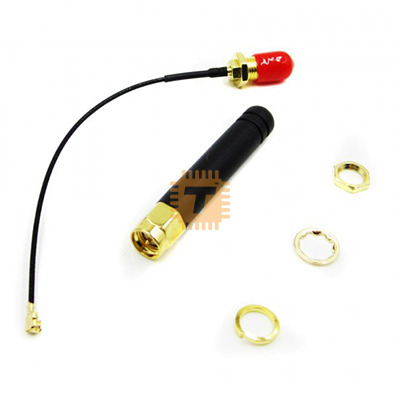
- Versatile Antenna Support: Features an SMA screw connector for the included stub antenna, plus solder footprints for IPEX micro-coaxial connectors and compact helical spring antennas.
- Integrated Audio Processing: Dedicated differential microphone and speaker breakout pins support voice calls and DTMF remote-control decoding.
Common Applications
- Remote IoT Telemetry: Logging environmental or agricultural data to remote cloud servers via GPRS TCP/UDP/HTTP.
- SMS Alert & Alarm Systems: Triggering instant security alerts, power outage notifications, or perimeter alarms to mobile phones.
- Remote Equipment Control: Switching relays and machinery via incoming SMS commands or DTMF keypad tones during a live phone call.
- Vehicle & Asset Monitoring: Telematics tracking when paired with a standalone GPS module.
Operating and Network Status Guide
- Connecting to PC / MCU: Connect module TXD to MCU/USB-TTL RX, and module RXD to MCU/USB-TTL TX. Ensure common GND is shared between the module and controller.
- LED Status Indicators:
- Flashing 1 time per second: Searching for network, SIM card missing, or registering to the cellular network.
- Flashing 1 time every 3 seconds: Successfully registered to the GSM network; idle and ready for AT commands, calls, and SMS.
- Rapid flashing (continuous): Active GPRS data transmission in progress.
Usage Tips
- Power Supply Headroom: Cellular modules draw brief current spikes up to 2A during RF bursts. Powering directly from a standard computer USB port or a weak 500mA regulator will cause brownouts and continuous reboots. Always use a dedicated 5V/2A or 12V/1A power supply.
- SIM Card Selection: Use a standard registered SIM card with an active voice/SMS plan. Ensure the network provider maintains active 2G (GSM) band coverage in your region.
- Antenna Requirement: Never transmit or power up the module without an antenna connected to the SMA port, as RF reflection can degrade the transmitter amplifier over time.
Frequently asked questions
What is the price of SIM800C GSM Module with Antenna Bluetooth in Sri Lanka?▾
The current price of SIM800C GSM Module with Antenna Bluetooth in Sri Lanka is Rs 3,350 at Tronic.lk.
Is SIM800C GSM Module with Antenna Bluetooth available in Sri Lanka?▾
Yes, SIM800C GSM Module with Antenna Bluetooth is currently in stock at Tronic.lk in Sri Lanka.
Where can I buy SIM800C GSM Module with Antenna Bluetooth in Sri Lanka?▾
You can buy SIM800C GSM Module with Antenna Bluetooth in Sri Lanka at Tronic.lk. Visit 37left.lk to compare prices across multiple shops and find the best deal.
Loading...