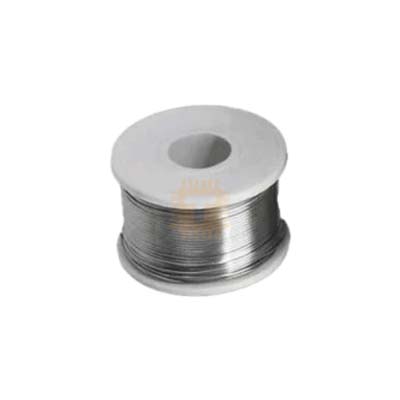
Solder Wire Lead Roll 60/40 0.8mm 400g High Quality
Price in Sri Lanka
Lead Solder Paste Flux and WicksTools and Accessories
Tronic.lk

Rs 4,920
In stock
Updated 01 Nov 2026
Opening hours
Closed now
- Monday09:00 - 19:00
- Tuesday09:00 - 19:00
- Wednesday09:00 - 19:00
- Thursday09:00 - 19:00
- Friday09:00 - 19:00
- Saturday09:00 - 19:00
- SundayToday09:00 - 19:00
Search for it on
Description
The Solder Wire Lead Roll 60/40 0.8mm 400g High Quality (0.8mm Versatile Gauge / 400g Large Workshop Spool) is a professional-grade electrical soldering alloy engineered to deliver the optimal balance between high-density SMD rework and standard through-hole PCB assembly. Formulated with a classic 60% Tin (Sn) and 40% Lead (Pb) metallurgical ratio, it features a low melting range (183°C–190°C) with a narrow plastic transition zone, providing rapid liquefaction, smooth capillary wetting, and fast joint solidification. Featuring an integrated, non-corrosive multi-channel rosin flux core (typically 1.8%–2.2%), the 0.8mm diameter offers precise volume metering for fine IC leads as well as passive components, while the 400g large spool size ensures long-lasting wire availability for high-volume manufacturing, lab prototyping, and continuous workbench servicing.
Specifications
- Alloy Composition: 60% Tin (Sn) / 40% Lead (Pb)
- Wire Diameter: 0.8 mm (±0.03 mm / Versatile All-Rounder Gauge)
- Net Solder Weight: 400 g (Gross spool weight approx. 430 g to 450 g)
- Flux Type / Core: Continuous Integrated Rosin Activated (RA) / Mildly Activated (RMA) Core
- Flux Content / Percentage: 1.8% to 2.2% (By weight)
- Melting Temperature Range:
- Solidus: 183°C (361°F)
- Liquidus: 190°C (374°F)
- Recommended Iron Tip Temperature: 310°C to 350°C (590°F to 662°F)
- Density: Approx. 8.5 g/cm³
- Electrical Conductivity: Approx. 11.5% to 12% IACS
- Flux Residue Characteristics: Light amber, transparent, non-conductive, non-corrosive under normal ambient conditions
- Spool Dimensions: Approx. 65 mm Diameter × 60 mm to 65 mm Height
- Spool Hub Hole Diameter: Approx. 20 mm (Standard benchtop dispenser spindle mounting)
Features
- Optimal 0.8mm All-Rounder Diameter: The ideal middle-ground gauge—fine enough to prevent solder bridging on SOIC and 0805/1206 SMD components, yet substantial enough to quickly solder standard DIP ICs, pin headers, and 20–24 AWG wires.
- Low Melting Point & Fast Capillary Flow: Melts consistently at ~185°C to ensure smooth wetting across pads with minimal thermal dwell time, protecting heat-sensitive semiconductors.
- Continuous Rosin Flux Core: High-activity internal flux cleans oxidized copper, tin, and nickel-plated surfaces on contact, eliminating the requirement for external flux in standard assembly.
- Bright, Mirror-Like Solder Fillets: Solidifies into shiny, concave joints that simplify visual quality inspections and resist thermal fatigue cracking.
- Heavy 400g Production Spool: Provides a high-capacity continuous wire supply on a single reel, reducing spool replacement downtime in repair centers and assembly lines.
Common Applications
- General PCB Assembly & Prototyping: Soldering standard through-hole components (DIP sockets, electrolytic capacitors, resistors) and medium SMD packages (SOIC, SOT-223, 1206/0805).
- Microcontroller & Development Boards: Populating header pins, terminal blocks, and DC jacks on Arduino, ESP32, STM32, and Raspberry Pi breakout boards.
- Audio & Instrument Wiring: Soldering 1/4" phone jacks, XLR connectors, potentiometers, and audio amplifier wiring harnesses.
- Drone & RC Electronics: Soldering flight controllers, 4-in-1 ESC power pads, receiver modules, and 18–22 AWG power distribution leads.
- Consumer Appliance & Electronics Repair: Recapping power supply boards, repairing fractured solder joints, and general appliance troubleshooting.
Usage Tips
- Recommended Soldering Iron Temperature: Set your temperature-controlled soldering station between 320°C and 340°C. Avoid running above 380°C to prevent burning off the internal rosin flux prematurely.
- Joint Heating Technique: Place the soldering iron tip against both the component lead and the PCB pad for 1 to 2 seconds to heat the joint evenly, then feed the 0.8mm wire into the junction opposite the iron tip until a clean, concave fillet forms.
- Flux Residue Removal: Rosin flux residue is chemically non-corrosive and non-conductive, but can be removed for a clean, professional finish using Isopropyl Alcohol (IPA ≥ 99%) with a soft brush or lint-free swab.
- Health & Safety Practices:
- Always work in a well-ventilated space or use an active solder fume extractor to clear airborne rosin flux fumes.
- Contains lead; wash hands thoroughly with soap and water after handling solder wire, and keep away from food and drinks.
- Storage: Keep the spool in a dry, room-temperature environment away from excessive humidity and corrosive fumes to maintain the wire's bright surface finish.
Frequently asked questions
What is the price of Solder Wire Lead Roll 60/40 0.8mm 400g High Quality in Sri Lanka?▾
The current price of Solder Wire Lead Roll 60/40 0.8mm 400g High Quality in Sri Lanka is Rs 4,920 at Tronic.lk.
Is Solder Wire Lead Roll 60/40 0.8mm 400g High Quality available in Sri Lanka?▾
Yes, Solder Wire Lead Roll 60/40 0.8mm 400g High Quality is currently in stock at Tronic.lk in Sri Lanka.
Where can I buy Solder Wire Lead Roll 60/40 0.8mm 400g High Quality in Sri Lanka?▾
You can buy Solder Wire Lead Roll 60/40 0.8mm 400g High Quality in Sri Lanka at Tronic.lk. Visit 37left.lk to compare prices across multiple shops and find the best deal.
Loading...